
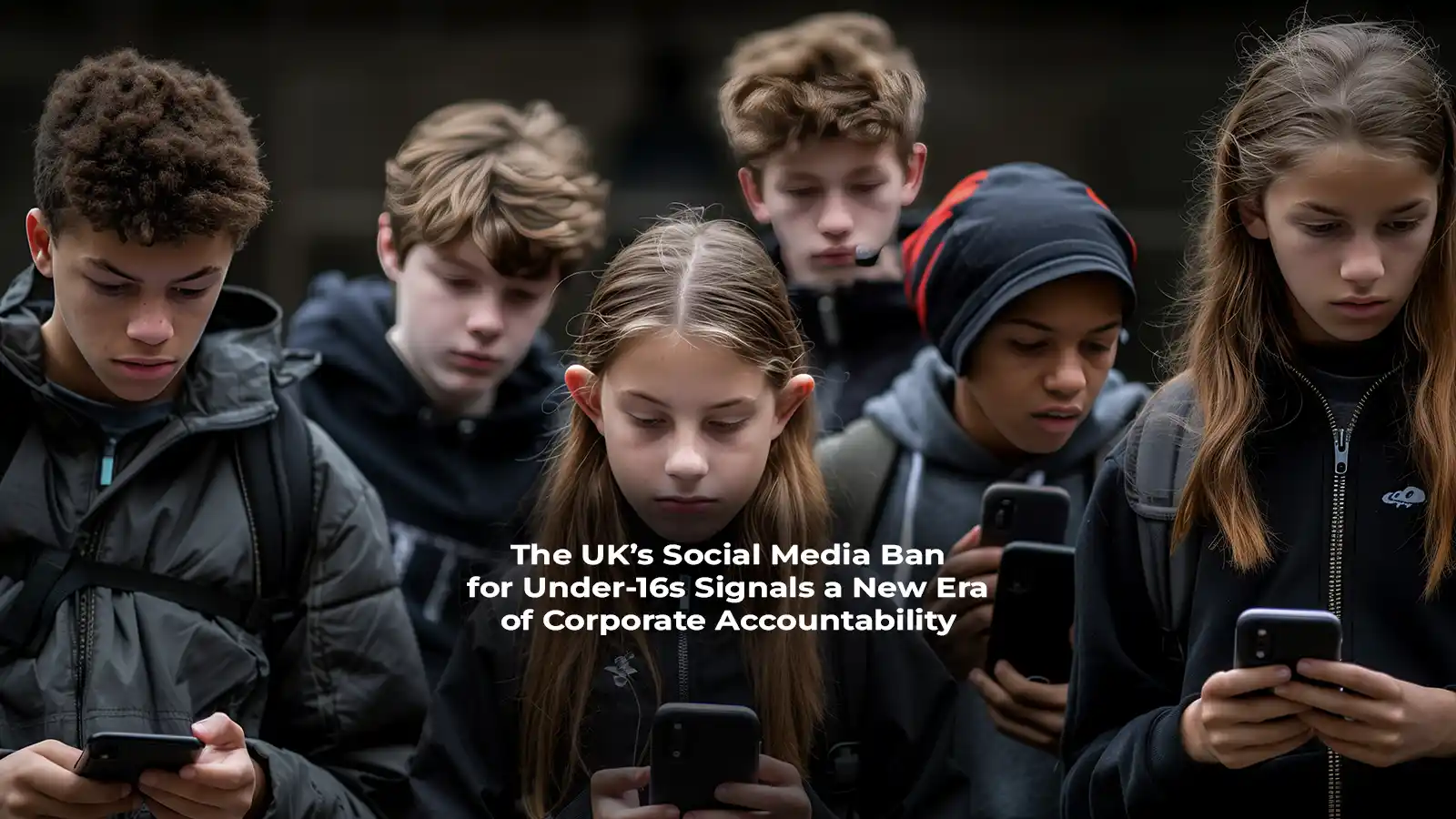
The UK’s Social Media Ban for Under-16s Signals a New Era of Corporate Accountability
In the UK education sector, this is an issue we are surrounded with on a daily basis. Parents ask on a daily basis, what is the mobile phone policy. Little did we know, in the meantime, that finally the UK government is playing the catch up game with the rest of the world on protecting children’s online presence.
The UK’s proposal to ban social media access for children under the age of 16 as on 2027 is being discussed primarily as a child protection measure. However, from a business and policy perspective, it represents something much larger: a fundamental shift in how governments view corporate responsibility in the digital age.
For years, technology companies have enjoyed extraordinary freedom to innovate, scale and monetise user engagement. During this period, social media platforms transformed how societies communicate, learn and conduct business. Yet alongside these benefits came growing concerns about mental health, online addiction, cyberbullying, misinformation and the exposure of children to harmful content.

The debate is no longer whether these risks exist. The debate is who should be held accountable for managing them.
Historically, responsibility has often been placed on individuals and families. Parents were expected to monitor their children’s online activity, while users were expected to navigate increasingly complex digital environments independently. This approach is now being challenged by policymakers around the world.
The UK’s proposed ban reflects a growing recognition that systemic risks require systemic solutions.
When a product presents potential harm to children, society does not rely solely on parental supervision. We regulate food safety, vehicle safety, pharmaceutical products and workplace environments. Digital platforms should not be exempt from similar standards simply because the product is software rather than a physical good.
This raises important questions for business leaders.
Should technology companies be responsible for preventing underage access to their platforms? Should internet service providers be required to offer stronger child protection systems by default? Should regulators impose substantial penalties when organisations fail to protect vulnerable users?

My view is that the answer to all three questions is yes.
The reality is that many social media platforms are designed around engagement-based business models. Success is measured by attention, activity and time spent on the platform. While this model has generated enormous economic value, it has also created incentives that may not always align with the wellbeing of younger users.
As regulators become more assertive, businesses must recognise that digital safety is rapidly evolving into a governance issue. Boards and executive teams will increasingly be expected to demonstrate how their products, services and technologies protect vulnerable groups.
This trend is unlikely to remain confined to social media companies. The principles being established today may eventually extend to artificial intelligence systems, gaming platforms, digital advertising networks and other emerging technologies.

Forward-thinking organisations should therefore view the UK’s proposal not as an isolated policy initiative but as an indicator of future regulatory direction.
The most successful businesses of the next decade will not simply be those that innovate fastest. They will be those that innovate responsibly.
The protection of children online is often framed as a social issue. Increasingly, it is becoming a business issue, a governance issue and a leadership issue.
The UK’s proposed ban may be controversial, but it sends a clear message: digital platforms can no longer separate commercial success from social responsibility.
For business leaders, the question is not whether regulation is coming. The question is whether organisations will adapt before they are forced to do so.